
Why I was quiet on the AI topic, and what I got wrong
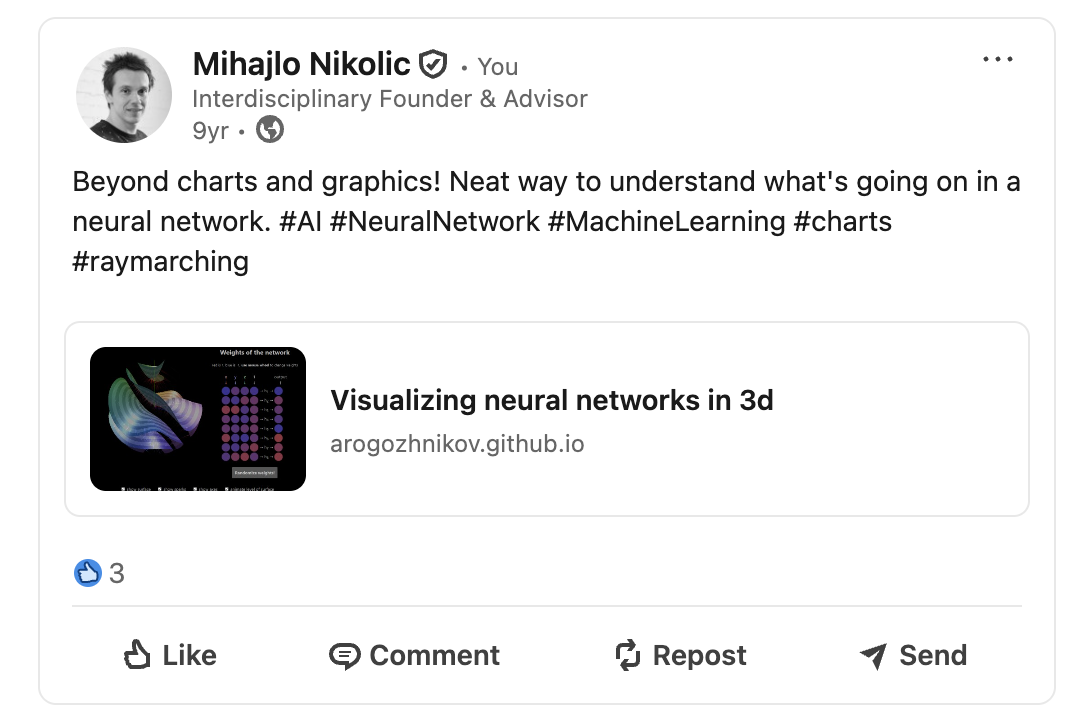
That’s a post of mine from 2017. Three people liked it. I’ve been writing and posting about AI and machine learning for over ten years, and this is roughly as much attention as any of it got. Then it became the hottest topic there is, and I went completely quiet. This article is me explaining both.
My two cents from the pre-LLM days
Or in other words… a bit of background for context.
Let’s go back a bit. Around 2012 we built a recommender system at Athlon for a web game platform. It suggested games based on a “DNA” profile of each player, created on the fly – a hybrid of collaborative filtering and per-user signals. It worked well. It was also completely deterministic: structured data in, useful patterns out. No LLM, no creative freedom, no surprises.
In 2015 I wrote a piece for The Wall UK on programmatic vs. editorial content. Rereading it now is a strange experience. I said you could teach a computer to finish Super Mario, but scale up the input and “you’re going to have to be very patient until your neural network gets to a place to spit out useful data.” And that until we got there, we’d keep using recommender systems that heavily rely on human input. Both turned out true. The waiting was shorter than I expected.
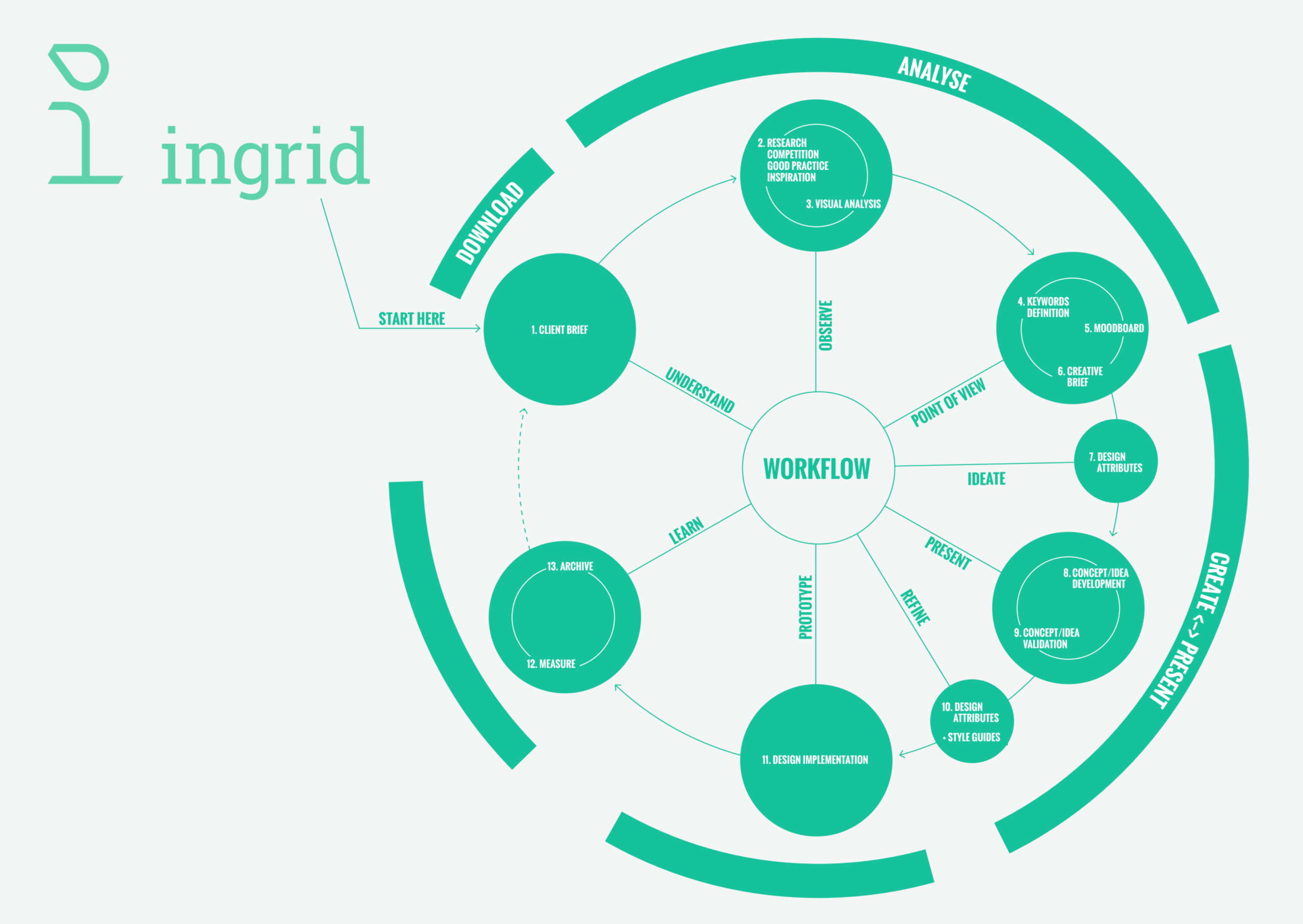
In 2016 I co-founded Ingrid (read in-grid, it was a nice name), a startup that gave UX recommendations, advice and audits, based on what the team knew about usability and interfaces plus the public body of knowledge on the subject. We pitched Y Combinator. We didn’t call it an AI project, because to us it was a UX product that happened to use machine learning. We didn’t get funded. That same year, AI was listed as a sector YC would invest in; around 10% of startups used AI (e.g. People.ai, Netomi / msg.ai, Caper). We had better chances of getting funded if we had the right positioning, a lesson I didn’t enjoy learning.
Around the same time I was posting on LinkedIn about whatever I found exciting. Somebody visualising neural networks in 3D. The EFF starting a project to track how much of AI is hype versus real progress. A JavaScript clone of OpenAI’s Universe.
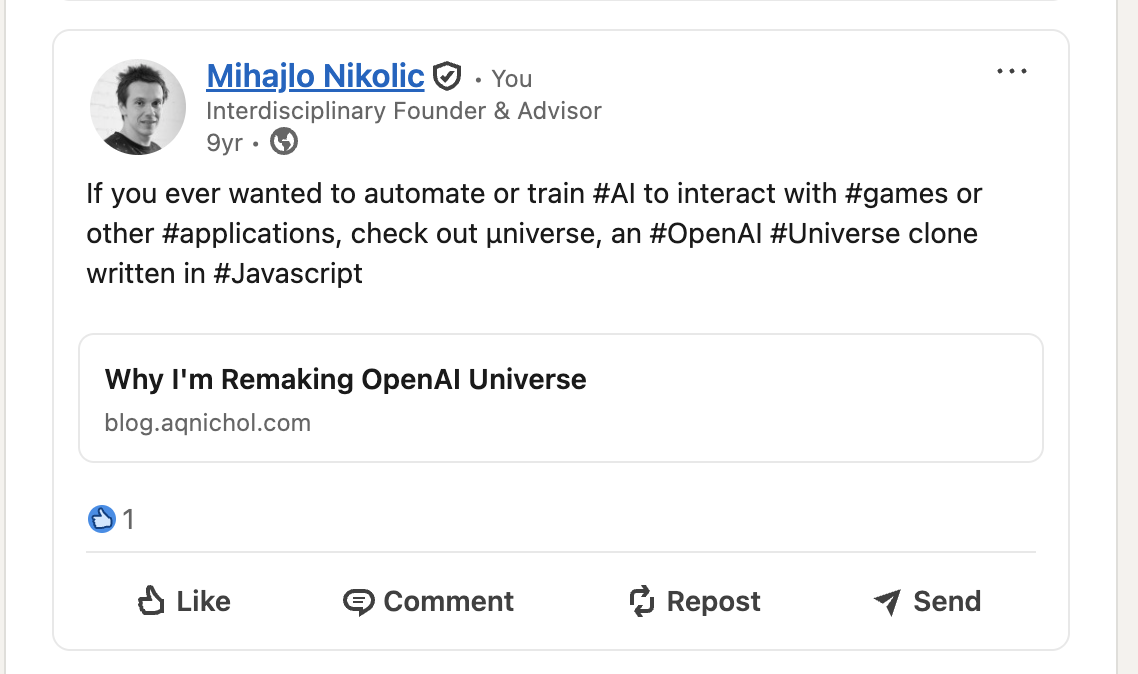
Yes, that's OpenAI, in 2017, in a post with one like. Nobody had heard of them. Including, apparently, my entire network.
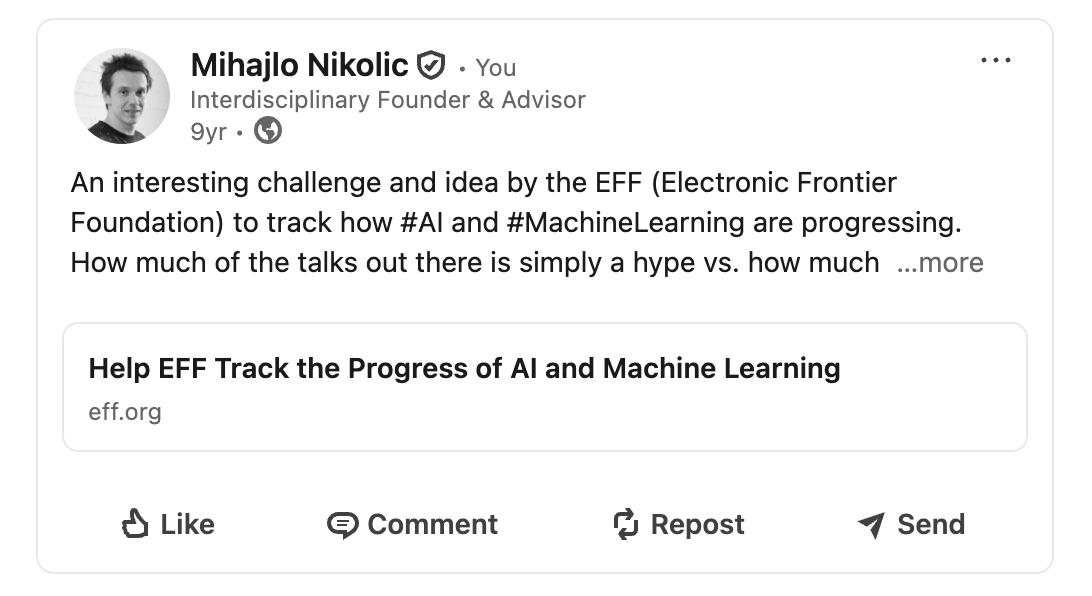
Zero reactions on this one. The question in that post aged well, but the post didn't.
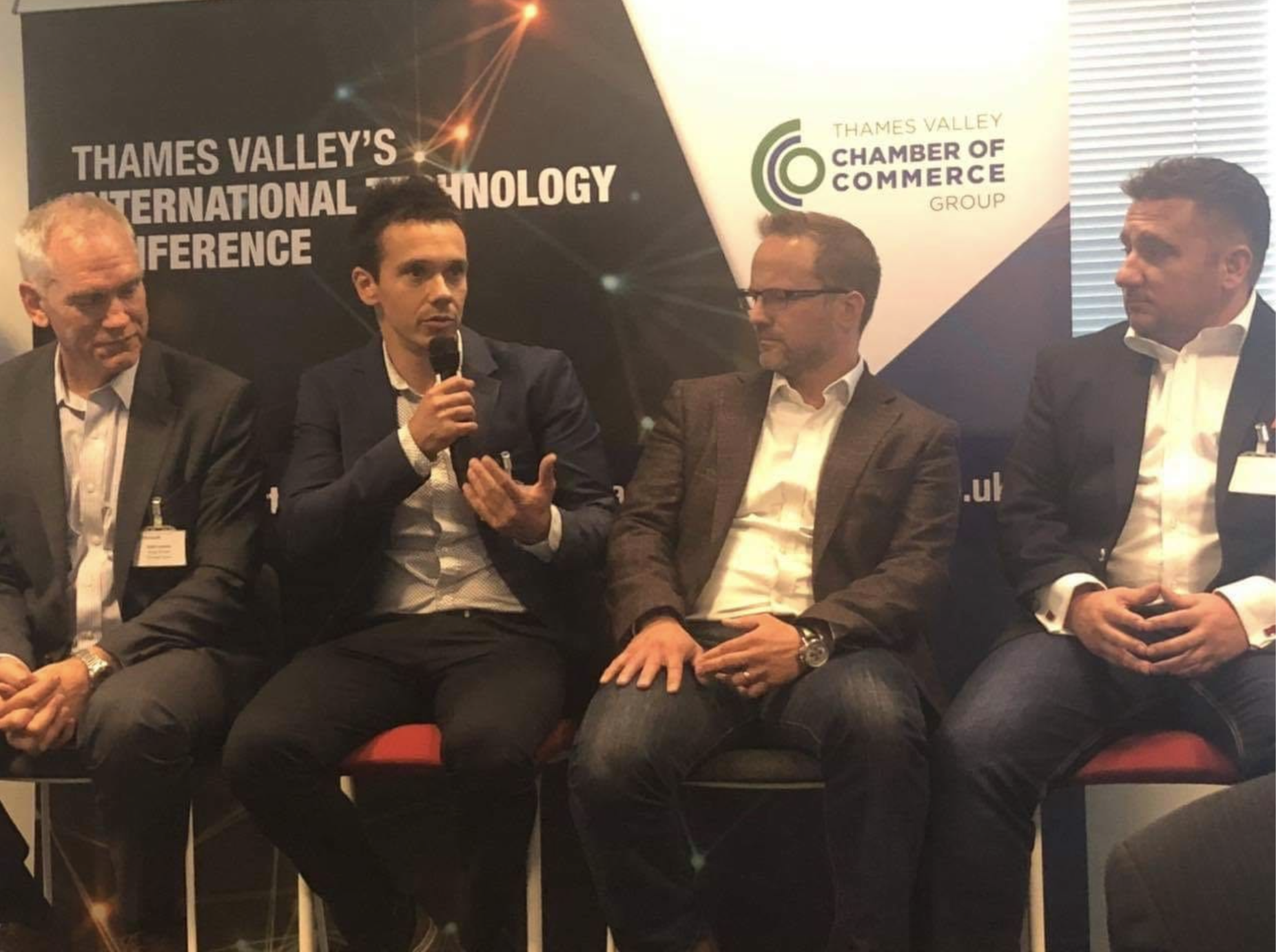
In 2019 I was invited to Microsoft’s UK HQ in Reading for a panel on “Human vs. Machine, the future of Human Potential”. What I said there, in short: computers are linear. Empathy, imagination, creativity, and seeing the bigger picture are ours. Hand the repetitive work to the machines and keep the interesting problems for us. Hold that thought; I’ll come back to it.
Why I went quiet
I wasn’t idle. Since then, a lot has happened: internal workshops for our developers when the LLM wave started, an MIT course on data science and machine learning in 2024-2025, a more hands-on one with fablabs.io earlier this year, the first AI workshops hosted at Resonator, and an “AI for educators” programme I led for university and K-12 teachers from across Europe, as part of an EU project. Many projects, and a lot of pivoting along the way – which models to use, which tools, how many of them, how to document. From the first days of the hype, I followed progress daily, and we experimented a lot with where and how to actually use this stuff. I was fully immersed, like a kid in a toy shop.
In autumn 2024, we built a company knowledge base that ran fully offline on a phone – Gemma 2 2B, retrieval on the device, a Flutter app. The model’s job was to understand what you were asking. The answer came from a RAG pipeline on the device: a smart search with context and deep links back to the source, a bit like Perplexity in your pocket without the internet. It worked alright for its time, and running a language model on a phone was still early days back then – Gemma 2 2B was two months old and Apple Intelligence hadn’t shipped yet.
I kept comparing what I could get out of RapidMiner and Dataiku by hand with what the models produced, and watched the gap close from “so-so” to reliable.
In 2025 I pulled 7 GB of my own Apple Health data to find out why my VO2 Max had dropped and then slowly recovered. I wrote a classifier that scored data points like temperature, breathing rate, and HRV for how likely they were to indicate illness, from unlikely to very likely, and overlaid that on VO2 Max and training load. The question was whether illnesses I hadn’t paid attention to, for example, a mild flu, explained the dips. And they did.
So why the silence? The honest answer is that the more I learned, the more I felt I was missing. There was too much happening to comment on any of it with a straight face. The reason is obvious now: nobody knows exactly what’s going on. We’re on the frontier; it’s super hard to keep up and filter noise from the useful stories.
Where does that leave me? I can’t call myself an expert. I’m a generalist – a polymath, if you’re being generous – and for years I treated that as something to apologise for. In an environment that changes this fast, it turned out to be the opposite. Depth in one model or one framework goes stale within a year. Context is what lasts: having seen recommender systems, the data science tooling, a few generations of frameworks, and now this, you can tell what’s actually new from what’s just loud. I’ve learned to value that instead of hiding it. I have more than a decade of context and enough hours with the tools to see what’s useful and what’s broken.
What I got wrong in 2019
In Reading I said computers are the linear ones and we’re the fuzzy, creative ones. Then large language models arrived, and the machine turned out to be the fuzzy, creative, unpredictable part. The linear, rule-based part we had to build around it ourselves.
The frame I find useful is Kahneman’s System 1 and System 2, rather than left brain / right brain (that split doesn’t hold up well anyway). The model is System 1: fast, fluent, confident, and wrong in systematic ways. The harness – the software, tests, and rules around the model – is System 2, written in code.
That says less about AI than about intelligence in general. This is how any creative intelligence gets made reliable. We never trusted our own System 1 with accounting either. We invented double-entry bookkeeping, checklists, compilers, and code review. An experienced pilot still reads the checklist.
We learned this the same way as everyone else, by getting it wrong first. There was a period where we over-specified everything: too many skills, too many docs, huge system prompts, too many plugins telling the model how to behave. On the larger codebases, the drift and the slow degradation of quality were obvious. What works best for us now is keeping things simple. The code is the documentation; separate files explaining what the code does go stale within days or weeks. We don’t trust a single-shot prompt for anything that matters. There are always checks in place, and the checks are code, not more prompt. Robert Martin (Uncle Bob) puts it well in a recent talk: a model treats your written instructions as guidelines rather than laws, so he wraps it in deterministic tools and a loop that says, in effect, change the code until this tool says it’s okay.
The other lesson from this period is unlearning. What worked with the previous generation of models can be useless, or actively harmful, with the next one. Half of staying current is throwing out last year’s tricks.
If I had to compress it into one rule: if it has to come out the same every time, it doesn’t belong in the prompt; it belongs in code. Asking a prompt for identical output every time is asking System 1 to do System 2’s job.
What’s next
I’m going to start writing about this again. I’ve stopped waiting until I’ve figured it out. The second part is already up: The convergence is in the reasoning, not in the learning – the two things I think are actually broken in the current generation of AI, how much it costs these systems to learn and how badly they do it compared to a five-year-old, and what building with them has taught me about how we think, remember, and make things up ourselves.
And it’s not only me. The Athlon team wants to be part of this conversation and help others work it out. What we’ve accumulated over the years is judgment about engineering problems, and that’s the thing missing in a lot of organisations right now. We’re working on some interesting projects, but the more interesting part is that we’re reinventing ourselves again. That’s nothing new; we’ve been adapting to the technology of the day for twenty years. What’s different this time is the speed of the change and how different the approach is. Calling it a new tool undersells it. Google Maps was a new tool; this feels different.
If you’re in the middle of the same thing, we’re all ears.